
Ask most owners what their kit is worth or whether it’s still under warranty, and the honest answer is a shrug — a gap that costs money as warranties lapse and insurance valuations become guesswork. Recording the financial details against each asset turns your inventory into a genuine financial register that answers the money questions your accountant and insurer depend on.
The numbers worth keeping on every item
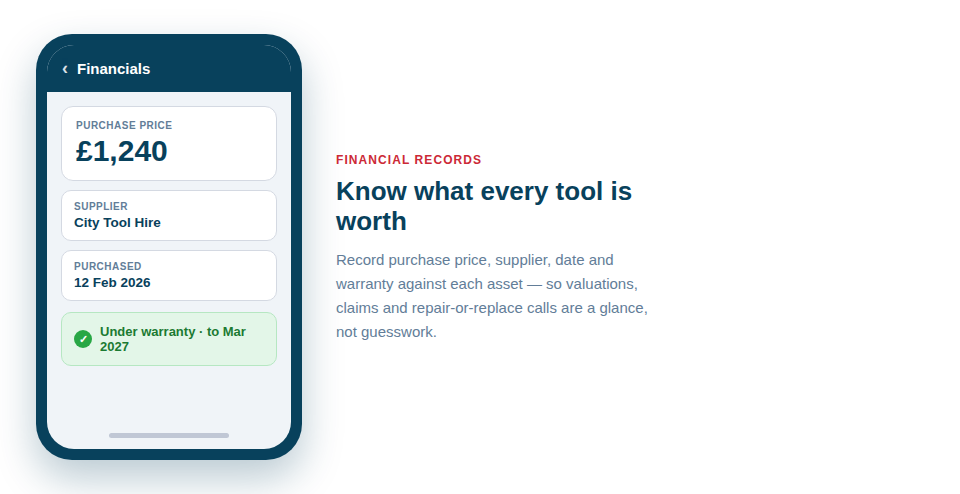
You can record as much financial detail as is useful, and even a few fields make a real difference:
- Purchase price — so you can value individual items and your whole inventory at a glance.
- Supplier — so re-orders and warranty claims go straight to the right place, with no detective work.
- Purchase date — the basis for depreciation, age analysis and replacement planning.
- Warranty expiry — arguably the most valuable of all, because it lets you claim before cover runs out rather than discovering the lapse afterwards. Set a warranty reminder once and Asset Giant tells you 30 days ahead — or however far ahead you choose — while there is still time to make the claim (see Alerts Before a Date Passes; included from the Crew plan).
From scattered invoices to clear decisions
Once these details live on each asset, a series of previously-painful tasks become straightforward. Valuing your equipment for insurance is a matter of filtering and exporting rather than a weekend of cross-referencing. Deciding whether to repair or replace becomes a sensible comparison of repair cost against the item’s age and original price. And when something is stolen or written off, you already hold the purchase evidence a claim requires.
All values are shown in your own currency, which you set once for your company, so figures always read naturally wherever they appear — on a record, in a filter, or in an exported report.
Best Practice: Capture the price and supplier at the moment of purchase, while the invoice is in front of you. Backfilling financial details across an existing fleet is tedious; recording them as you go is almost effortless.
For more detail, see What a Tool Cost and What It’s Worth Now.