
Search for free asset tracking software and every result says “free”. Click through, and “free” usually means a 14-day trial, or a plan capped so hard it can’t run a real business — a dozen items, one user, no labels, no export. If you’re a small trades or events outfit trying to get control of your kit without adding a subscription, the caps are the whole story. Here’s how to read them.
The five questions that expose a fake free plan
- Is there a time limit? A “free trial” is not a free plan. A real free tier has no expiry date.
- How many assets and users? A one-person cap rules out even a two-person firm. Check whether the numbers cover your van, or just a demo.
- Are QR labels and scanning included? Labelling is what makes tracking stick. If label printing or the scanner sits behind a paywall, the free tier can’t do the job.
- Can you export? CSV or PDF export on the free tier means your data is yours. No export means lock-in — you’ll pay to leave.
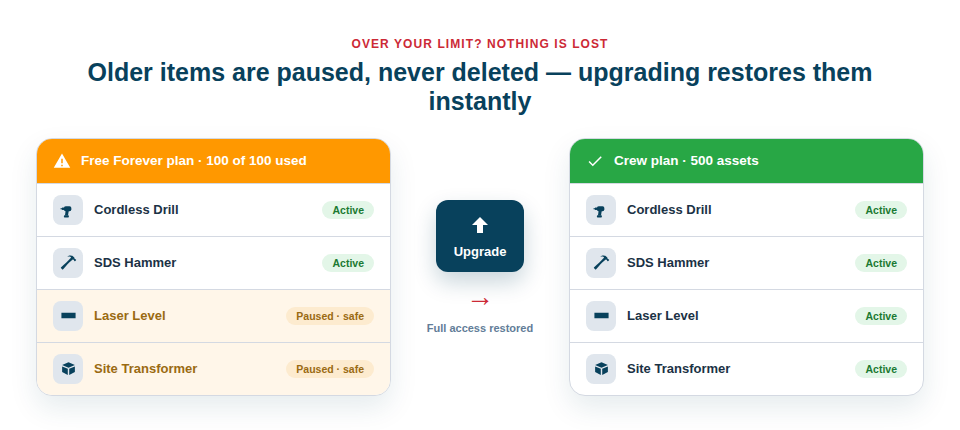
- What happens when you outgrow it? The good answer: nothing is deleted, you upgrade when ready. The bad answer: your account is frozen until you pay.
How Asset Giant answers those five questions
We built our Free Forever plan to pass exactly this test, because we were fed up with the trials-in-disguise too:
– No time limit, no card. Free Forever is the permanent bottom tier, not a funnel trick.
– Real limits you can work within — enough assets and AI allowance to run a small operation, with flat, transparent paid tiers when you grow. The exact numbers are on the pricing page.
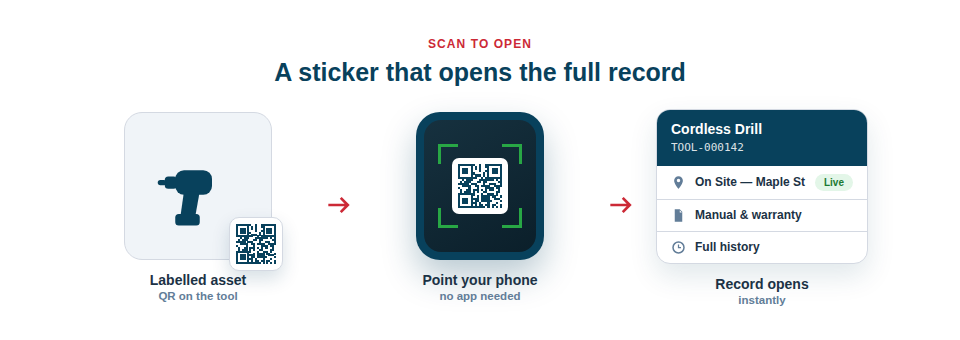
– QR labels and mobile scanning included. Generate codes, print them on standard Avery-style sheets and scan with your phone camera — the full loop, free. Start with QR Code Asset Tags & Labels.
– Export on every plan, and the over-limit rule is pause-not-delete: Your Data Is Never Held Hostage.
How the well-known names stack up
The established players — Sortly, EZOfficeInventory, Asset Panda, itemit, ShareMyToolbox — are capable systems, and for some businesses a paid tier of one of them is the right call. But their free offerings (where one exists at all) tend to fail at least one of the five questions above, usually on asset caps, label printing or export. We keep a feature-by-feature breakdown on our comparison page so you can check the current details side by side rather than take our word for it.
The quickest test, though, is practical: open a free account, photograph a shelf of tools, and see whether you have a working, scannable inventory by the end of a tea break. That’s the standard “free” should meet.