
Ask any foreman where tools go and you’ll get the same answer: nowhere dramatic. They’re not usually stolen — they’re left on the last job, buried in the wrong van, or “borrowed” by someone who genuinely meant to bring them back. The common thread is that nobody can say who had it last. Fix that one fact and most losses simply stop happening. Here’s a routine that does it without paperwork, and without anyone on the crew having to care about “asset management”.
Why tools actually go missing
Three patterns cover almost every lost tool:
– No home: the tool has no fixed place it lives, so nobody notices it’s gone until it’s needed.
– No handover: it moved van-to-van or person-to-person with no record, so “who had the big SDS?” becomes an argument instead of a lookup.
– No check: nobody counts kit back in at the end of a job, so losses surface weeks later — far too late to recover anything.
Any fix has to close all three, and it has to be faster than not doing it, or the crew will quietly drop it by Friday.
The routine: label once, scan always
Step 1 — label everything worth chasing. Give every tool a QR label and a home location (a van, a store, a shelf). Labelling a whole fleet sounds like a chore; with bulk pre-printed stickers it’s an afternoon — print a sheet, stick them on, scan each one to link it. The full method is in Pre-Print QR Codes in Bulk.
Step 2 — scan on every handover. When a tool changes hands or vehicles, whoever takes it scans it with their phone and checks it out. Two seconds, no typing. Now every tool has a live answer to “who had it last, and where”: Check Items In & Out.
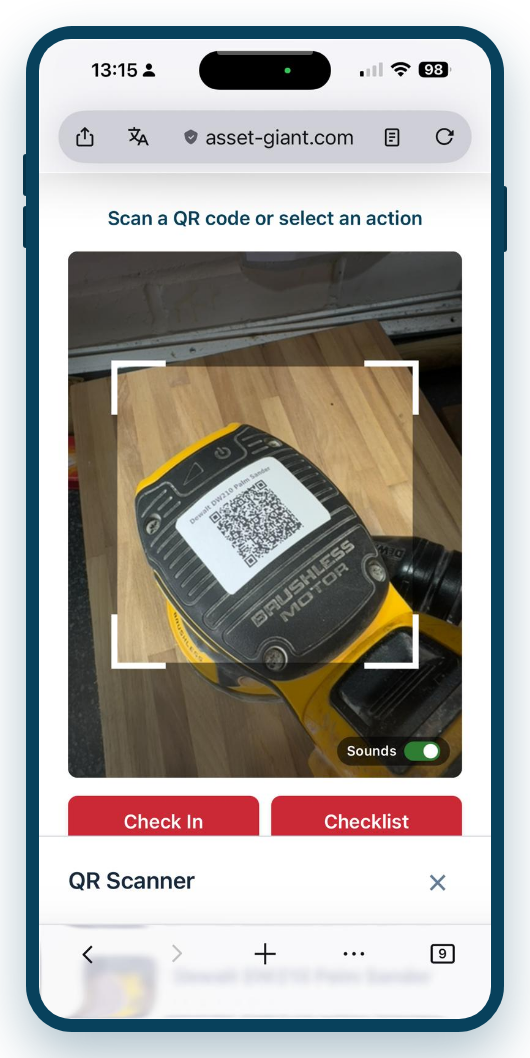
Step 3 — count back in with a stocktake. At the end of a job (or Friday afternoon), scan the van or store and let the system compare what’s actually there against what should be. Anything missing is flagged while the trail is still warm: Stocktakes & Inventory Audits.
Making it stick with the crew
The system survives only if it’s easier than the old way. A few things that help:
– Phone camera, no app installs — the scanner runs in the browser, so there’s nothing for anyone to download or update.
– Make the label the door key: train the habit as “scan it when you take it”, the same reflex as tapping a fuel card.
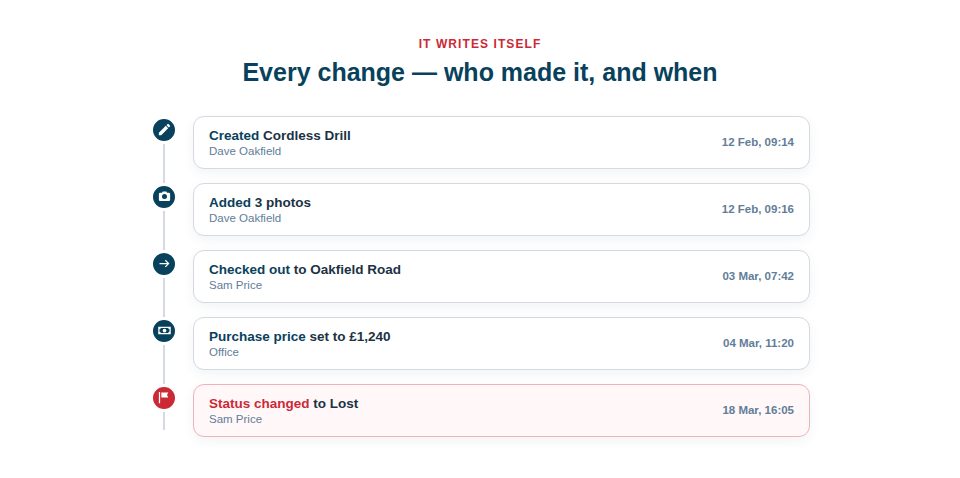
– Let the audit trail do the enforcement. Nobody has to accuse anyone — the record just says who scanned it out. Accountability without the awkwardness. That alone changes behaviour in a week.
– Start with the expensive stuff. Label the top fifty tools first; momentum does the rest.
The whole routine runs on Asset Giant’s Free Forever plan — labels, scanner and history included, no card needed. Set it up free and the next “where’s the laser level?” takes five seconds to answer.